


A new investigation published by The Standard has reignited national debate on police accountability in Kenya, raising serious questions about whether senior police commanders are shielding officers implicated in repeated cases of alleged brutality and unlawful killings.
According to the report, police leadership is accused of engaging in public relations manoeuvres while declining to name officers caught on CCTV or linked to violent incidents, instead attributing responsibility to unnamed administrators.
Critics argue that this approach has contributed to a cycle of impunity, allowing similar incidents to recur across the country.
The publication traces a pattern of alleged abuse stretching from the Nandi Hills area to urban centres, citing incidents that include violent beatings in a pool hall and aggressive raids during church services.
In each case, questions have been raised about the conduct of individual officers and the apparent lack of transparent disciplinary outcomes.
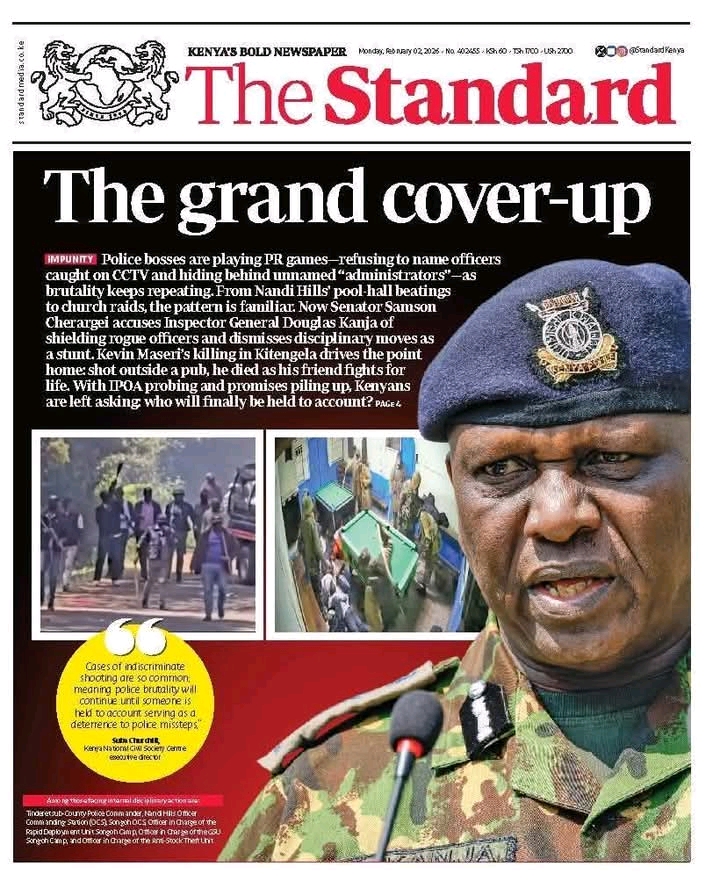
Particular attention is drawn to the fatal shooting of Kevin Maseri in Kitengela. Maseri was reportedly shot outside a pub, dying at the scene, while his friend sustained life threatening injuries.
The case has become emblematic of wider public frustration, with rights groups and families of victims demanding clear identification and prosecution of those responsible.
The Independent Policing Oversight Authority (IPOA), which is mandated to investigate deaths and serious injuries caused by police action, is reported to be handling multiple cases linked to indiscriminate shootings and excessive use of force.
However, civil society organisations argue that investigations alone are not enough if officers are not publicly named and swiftly held to account.
Kenya National Civil Society Centre executive director Suba Churchill is quoted warning that such cases have become so common that brutality risks being normalised unless firm action is taken.
He argues that accountability must serve as a deterrent, noting that without consequences, police misconduct is likely to continue.
The matter has also reached the political arena. Senator Samson Cherargei is cited as accusing the Inspector General of Police, Douglas Kanja, of protecting rogue officers and dismissing announced disciplinary measures as cosmetic.
The senator’s remarks reflect growing unease within Parliament over whether internal police processes are sufficient to restore public trust.
The report further notes that while some officers have been said to face internal disciplinary action, details remain scarce.
This lack of transparency has fuelled suspicion among the public, especially when video evidence circulates widely on social media without clear follow up information on arrests, suspensions or prosecutions.
Even as IPOA probes continue and promises of reform accumulate, many Kenyans are left asking a fundamental question: who will ultimately be held responsible?

