

KCB Group Plc posted KShs. 68.4 billion in profit after tax for the full year ending December 2025, marking a strong financial performance for the banking group.
The results were driven by higher net interest income as the Group continued to deepen its operations across the region.
Despite a challenging operating environment, the bank recorded steady growth across key business lines supported by disciplined execution and sustained cost management.
Total revenues grew to KShs. 214 billion from KShs. 204 billion in a similar period the previous year, representing a year-on-year increase of 13.8 percent.
Customer loans also grew by 15 percent to close at KShs. 1.59 trillion. Non-funded income contributed significantly to the results, delivering 31 percent of the total revenues on the back of investments in digital banking and innovative financial solutions.
The Group maintained a strong balance sheet with total assets growing by 9.3 percent to close at KShs. 2.15 trillion, despite divesting from the National Bank of Kenya.
The growth was used to fund interest earning assets which closed at KShs. 1.84 trillion.
Speaking during the announcement of the financial results on Wednesday, KCB Group CEO Paul Russo said the performance reflects the strength of the KCB franchise and the resilience of its regional footprint.
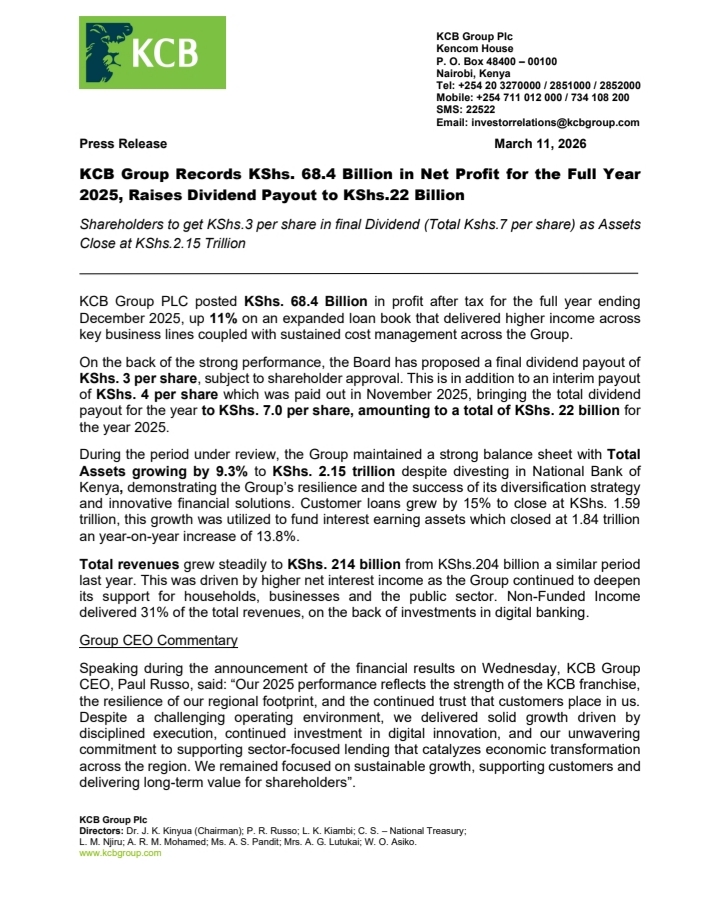
He added that the results also demonstrate the continued trust that customers place in the bank and its commitment to supporting sector-focused lending that catalyzes economic transformation.
On the back of the strong performance, the Board has proposed a final dividend payout of KShs. 3 per share subject to shareholder approval.
This will be in addition to an interim payout of KShs. 4 per share that was paid out in November 2025, bringing the total dividend payout for the year to KShs. 7 per share amounting to about KShs. 22 billion for shareholders.
The Group maintained strong capital and liquidity levels with core capital as a proportion of total risk weighted assets closing at 18.4 percent against the statutory minimum of 10.5 percent.
Total capital to total risk weighted assets ratio stood at 22.1 percent against a regulatory minimum of 14.5 percent while the liquidity ratio was 50.8 percent compared to a regulatory minimum of 20 percent.
The bank also maintained a stable deposit franchise across all markets with deposits closing at KShs. 1.25 trillion driven by growth from new customers across key sectors of the economy.
On the balance sheet side, the stock of gross loans and advances rose 16.2 percent to KShs. 1.59 trillion.Looking at asset quality, the non-performing loans ratio improved to 16.9 percent from 19.2 percent following a proactive rehabilitation strategy, aggressive recovery efforts and the hive out of National Bank of Kenya.
The stock of gross non-performing loans stood at KShs. 211.8 billion down from KShs. 225.7 billion the previous year.
The Group also reported strong returns for shareholders with Return on Equity standing at 22.5 percent while Return on Assets was recorded at 3.3 percent, signaling efficient deployment of equity to generate returns.
KCB continued to benefit from its regional diversification strategy with subsidiaries excluding KCB Bank Kenya contributing 30.7 percent of profit before tax and 30.5 percent of the Group balance sheet.
The three non-banking subsidiaries also delivered strong performance. KCB Bancassurance Intermediary recorded KShs. 1.14 billion representing 29 percent growth.
KCB Investment Bank posted KShs. 348 million representing 31 percent growth while KCB Asset Management reported KShs. 160 million representing 54 percent growth.
The Group’s focus on cost management saw the cost to income ratio drop to 42.5 percent from 45.4 percent the previous year while overall operating expenses declined by 2.5 percent year on year.
Looking ahead, the bank remains optimistic about sustained business activity and economic growth prospects across the markets it operates in, although it continues to monitor global uncertainties attributed to heightened geopolitical tensions and higher tariffs.
KCB Group Chairman Dr Joseph Kinyua said the performance reflects the success of the Group’s multi market growth model and its ability to leverage opportunities across East Africa while delivering long term value to shareholders.
The Group continued to deepen its digital footprint with a new unified mobile app focused on payments, saving and investments among other capabilities.
In November, KCB Group Plc entered into an agreement to invest in Pesapal Limited in a transaction expected to accelerate commerce and create pathways to prosperity while driving digital and inclusive growth for businesses across Africa.
The transaction is subject to conditions that are customary to transactions of this nature including receipt of regulatory approvals.
In January this year, KCB Group received approval from the Competition Authority of Kenya to acquire a 75 percent stake in the payments technology firm Pesapal.
In December, the African Development Bank Group and KCB Bank Kenya Limited signed a 150 million dollar financing package to support green finance and accelerate climate smart investments aimed at enhancing KCB’s trade finance capacity within the growing small business and corporate banking sector in Kenya.
KCB Bank Kenya also set aside KShs. 227 million for the 2026 World Rally Championship Safari Rally Kenya which will take place in Nakuru, marking the sixth consecutive year of sponsorship since the iconic rally returned to the country.
The Group has also continued to support communities in the markets where it operates through various targeted sponsorships and corporate social investment initiatives while maintaining strong Environmental, Social and Governance commitments to safeguard people and the planet.
KCB Group Plc is East Africa’s largest commercial bank established in 1896 and headquartered in Kenya. The Group has operations in Tanzania, South Sudan, Uganda, Rwanda, Burundi and the Democratic Republic of Congo. Its subsidiaries KCB Bank Kenya and Trust Merchant Bank also have representative offices in Ethiopia and Brussels.
The bank operates one of the largest branch networks in the region with more than 450 branches, 1,249 ATMs and over 1.3 million merchants and agents offering banking services on a 24-hour basis supported by mobile and internet banking platforms.

