


The Judicial Service Commission (JSC) has come under renewed scrutiny following an audit by Auditor General Nancy Gathungu that revealed several challenges affecting the institution’s operations during the financial year ending June 2025.
According to the audit report, the commission is facing a significant staffing shortage that could affect its ability to effectively carry out its mandate.
The report shows that JSC currently has only 67 employees despite having an approved workforce of 166. This means that nearly 60 percent of the required positions remain vacant, raising concerns about efficiency and service delivery within the body responsible for overseeing the judiciary and protecting judicial independence.
The audit also highlighted concerns regarding compliance with constitutional requirements on inclusivity.
Auditors found that there were no Persons with Disabilities (PWDs) among the commission’s staff or commissioners.
This situation is said to be inconsistent with Article 54(2) of the Constitution of Kenya, which requires public institutions to promote inclusion and representation of persons living with disabilities.
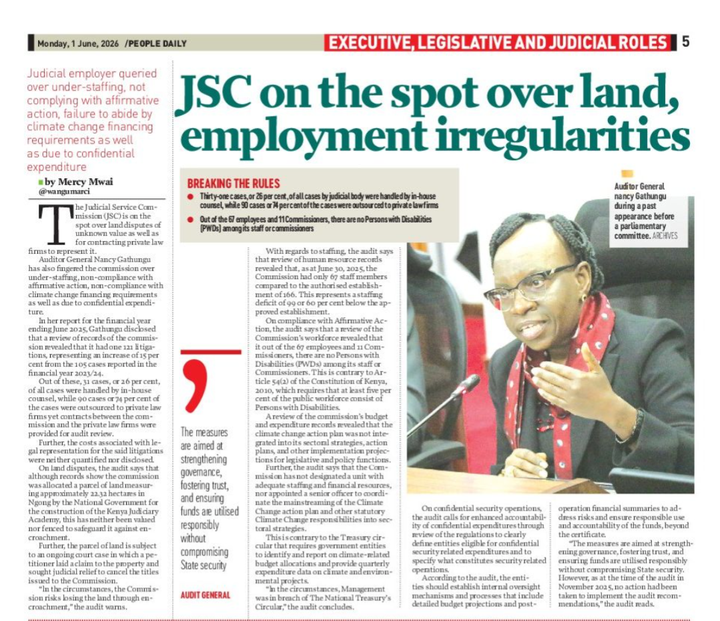
Questions were also raised about the commission’s handling of legal matters and related expenditure. During the review period, the commission handled 121 legal cases, but 90 of them were outsourced to private law firms. However, auditors noted that contracts supporting these legal services were not provided for review.
In addition, the total amount spent on the outsourced legal services was not clearly disclosed, creating concerns about transparency and accountability.
The report further identified weaknesses in the commission’s management of land assets.
A 22.32-hectare parcel of land in Ngong was found to be unfenced and inadequately valued, making it vulnerable to possible encroachment. The situation is further complicated by an ongoing court case challenging the validity of the ownership documents related to the property.
Another issue highlighted in the audit concerns compliance with government climate change requirements.
The commission had not incorporated climate action plans into its operations and had also failed to appoint a senior officer responsible for overseeing environmental compliance, as required by National Treasury guidelines.
Perhaps most notably, the Auditor General reported that by November 2025, the commission had not made meaningful progress in addressing the issues raised despite recommendations aimed at improving governance, accountability, and overall institutional performance.
The findings are likely to increase pressure on the commission to implement reforms and strengthen its internal systems.

