


Michael Makarina, a well-known political figure in Meru and once a strong supporter of government policies including the Social Health Authority, recently found himself facing a painful reality.
On July 15, 2025, he suffered a mild stroke that required urgent hospitalization. Despite being a platinum subscriber to the SHA system, he was shocked to discover that the Social Health Insurance Fund, which is supposed to support citizens in such medical situations, failed to cater for even a reasonable part of his hospital bill.
This forced him to seek help from former Director of Criminal Investigations George Kinoti, who stepped in to pay the rest of the bill.
Makarina, who had often paraded his loyalty to government programs by saying “System iko sawa” in public events, is now singing a different tune. His experience with SHIF has changed his outlook completely.
After relying on the system he once championed, only to be disappointed during a health emergency, he now describes SHIF as a sugarcoated scam.
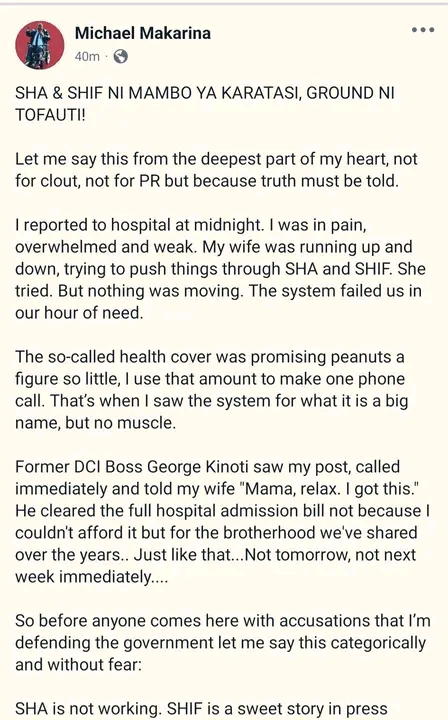
He compared it to Nkubu miraa—sweet in the beginning but eventually leaves a bitter taste, capturing his sense of betrayal. What stings even more is that he had previously dismissed and mocked Gen Z protesters who were voicing the same concerns he now has.
The young people who filled the streets to criticize poor governance and failed public systems were once called lazy and misguided by Makarina. But now, with his own body failing and the system letting him down, he sees their point clearly.
His public criticism of SHIF after his hospitalization has attracted wide attention, with many Kenyans pointing out the irony of someone who once praised the very system that left him stranded.
The situation reveals how disconnected some leaders are from the reality faced by ordinary citizens. Makarina had always lived a flamboyant life, even claiming on social media that he earns millions daily.
Yet when health challenges struck, not even his wealth or SHA status could protect him from the broken system he once supported.
His survival ended up depending not on his platinum card but on the goodwill of a former state officer.
This incident is not just about Makarina. It opens a wider conversation on whether Kenya’s healthcare reforms under SHA and SHIF are truly benefiting the people or just existing on paper.
If a public figure like Makarina couldn’t be served properly despite paying for the highest level of subscription, it raises fears about what ordinary Kenyans go through. His sudden shift in position also confirms what many critics have been saying, the system only seems to work until the day you really need it.
What’s more troubling is the role that political loyalty has played in masking the failures of such public systems. Makarina’s case is a clear warning that blind support for government programs without holding them accountable can be dangerous.
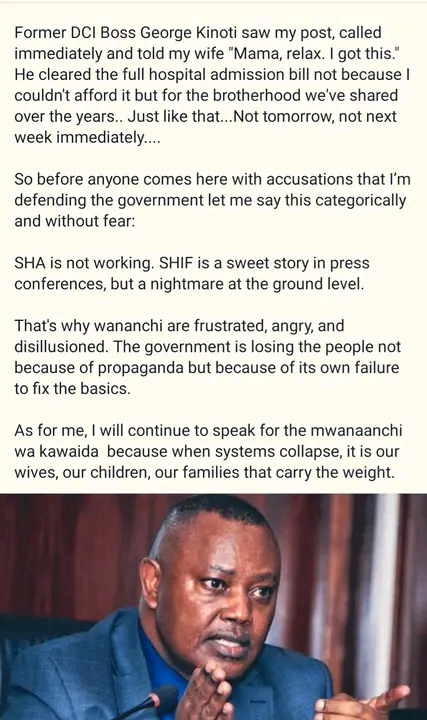
Today it is Makarina, tomorrow it could be any other citizen who believed the promises and trusted in the system. His ordeal is now a talking point across social media, with people reflecting on how many others have suffered silently under the same conditions.
It remains to be seen if this incident will change how Makarina approaches politics or if it will only serve as a personal lesson. But what is clear is that his voice has now joined the growing number of Kenyans calling out the failures in the healthcare system, something he once ignored.

