


Reports from Iranian state media say that Mansoureh Khojasteh Bagherzadeh, the wife of Ali Khamenei, died on March 2, 2026.
Her death is said to have followed a recent airstrike that was carried out by forces linked to the United States and Israel.
The incident has added more tension to an already serious conflict in the region.
Bagherzadeh was born in 1947 in Mashhad, Iran, into a religious family. In 1965, she married Khamenei, who later rose to become Iran’s Supreme Leader in 1989.
For decades, she remained largely out of public view, focusing on her family life while standing beside her husband during his long leadership.
Her role was mostly private, and she rarely appeared in political events or public debates.
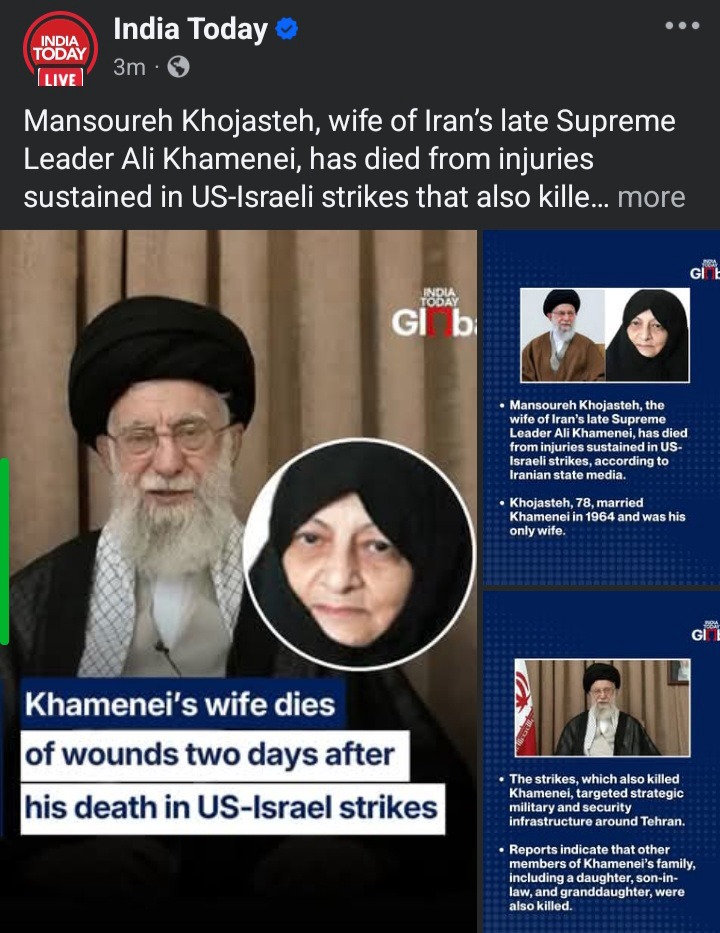
The death of her husband was reported just days earlier, on February 28, 2026, also as a result of an airstrike. His passing triggered nationwide mourning, with many Iranians gathering in different cities to honor his memory.
Government officials declared periods of national grief, and state institutions lowered flags in respect. The back-to-back deaths of the couple have deeply affected supporters and have intensified emotions within the country.
Together, they had six children, including three sons named Mostafa, Mojtaba, and Masoud, as well as two daughters. Over the years, their family remained closely connected to Iran’s political and religious leadership.
While Bagherzadeh did not take an active political role, she was seen as a steady presence throughout her husband’s nearly four decades in power. His time in office was marked by internal political divisions, economic sanctions, and long-running disputes with Western nations.
Her death comes at a time of ongoing confrontation following the attacks that claimed the lives of Khamenei and other close family members. Iranian leaders have strongly condemned what they describe as acts of aggression.
They have promised a firm response and called for unity among citizens. The situation has further strained relations between Tehran and its regional rivals, raising concerns about what may happen next in an already unstable environment.

