


Civil society activist Peter Agoro has found himself at the centre of a corruption storm that touches not only his personal life but also Kenya’s fight against graft.
What began as his attempt to expose corruption at the Kenyatta International Convention Centre has turned into a legal battle that raises deep questions about how state institutions are used, who they protect, and how far they go to silence critics.
Agoro maintains that he was framed after refusing a bribe and that the chain of events that followed was designed to destroy his credibility and bury the scandals he had exposed.His petition before the High Court lays out a sequence of events that started in September 2024.
After he filed a petition seeking documents tied to corruption allegations at KICC, Agoro says the management, with help from powerful allies in the Ethics and Anti-Corruption Commission, moved against him.
He narrates how KICC CEO James Mwaura invited him for a meeting at Pan Africa Hotel where he was allegedly forced to take bundles of US dollars.
When he resisted, he claims police officers suddenly appeared, ambushed him, and made sure photographs were taken showing him with the bag of cash. He was later dragged to EACC headquarters, detained overnight at Kilimani Police Station, and released on a KSh 100,000 bail.
For Agoro, this was not a legitimate arrest but an entrapment meant to discredit him. He argues that the smear continued when EACC issued a press statement branding him as part of an extortion racket.
The statement left out Mwaura’s role completely, and the images of him in handcuffs were widely circulated in the media. According to him, this was deliberate and calculated, turning him from an activist into a suspect in the public eye while shielding those accused of corruption.
The damage has been lasting. More than a year later, the defamatory material still exists online, outliving the timeframe in which he could file a defamation case.
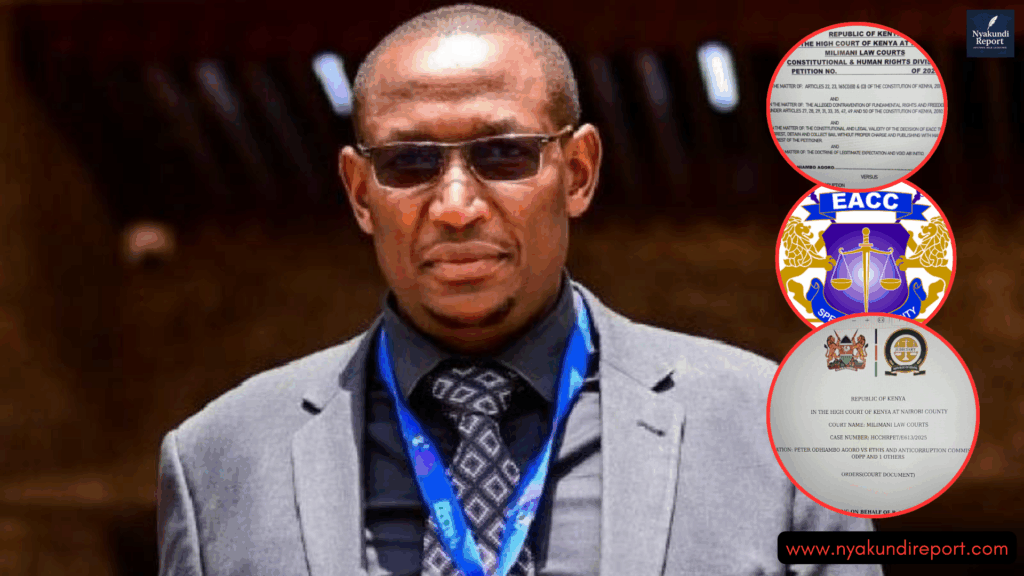
This, he says, has denied him the opportunity to legally clear his name. His professional reputation has been damaged, his standing in civil society circles undermined, and his activism viewed with suspicion.
In his constitutional petition, Agoro is asking for remedies that go beyond clearing his name. He wants the defamatory statement withdrawn, the criminal case terminated, and his bail money refunded.
He also seeks declarations that his rights under the Constitution, including dignity, access to information, fair hearing, and freedom of expression, were violated.
Agoro has turned his personal fight into a test of whether Kenya’s institutions protect whistleblowers or punish them.The High Court has already set strict timelines. Justice Bahati Mwamuye directed that Agoro must serve his petition within seven days, with respondents given the same period to reply, after which Agoro may file his rejoinder.
The case will return to court on November 6, 2025, for further directions. What happens on that date could determine whether the petition moves forward or gets lost in procedural delays.
What makes this case significant is not just the personal injustice alleged but the wider implications for governance. Agoro believes he was targeted because he exposed irregular procurement and tenders awarded to companies linked to close associates of senior officials.
More than a year later, no formal charges have been filed against him, suggesting that the case may have been less about justice and more about silencing a whistleblower.
This situation paints a troubling picture of how institutions like EACC can be turned into tools to protect the powerful while punishing those who dare to challenge them. For civil society, the case is a warning that activism carries risks that can destroy reputations and careers long before any truth is established in court.
The big question is whether the judiciary will provide a safe space for whistleblowers like Agoro or whether his fight will be another example of justice denied. Whatever the outcome, his ordeal has already exposed the uneven battleground on which Kenya’s war against corruption is being fought.

