


Absa Bank Kenya has once again found itself at the center of controversy after a long-time client reported a disturbing case of unauthorized withdrawals from her account.
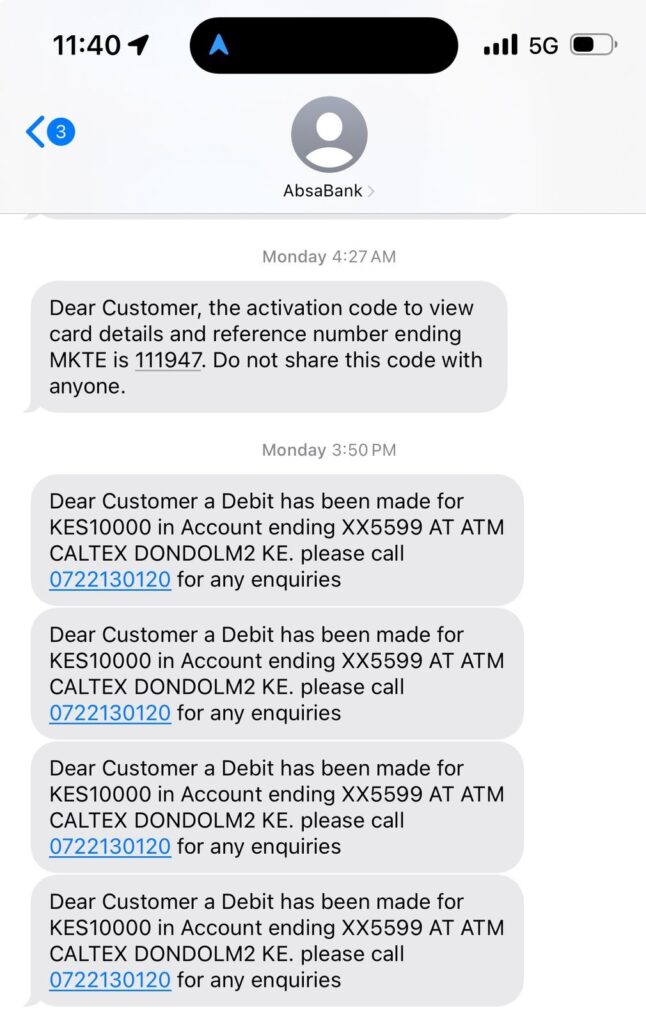
The client says she received a text message earlier in the week alerting her that four withdrawals amounting to KSh 40,000 had been made from an ATM in Donholm, Nairobi, a machine she had never used.
What followed was a frustrating journey of internal investigations, mixed instructions, and repeated referrals to law enforcement that revealed glaring weaknesses in the bank’s systems and its handling of customer grievances.
The incident began on Monday, 1 September 2025, when the four withdrawals, each of KSh 10,000, were processed within minutes. Alarmed, she immediately reached out to Absa Bank, only to be informed that her account would be blocked and she should report to the Sarit Center branch the next day to meet the fraud unit.
When she visited, she was advised not to involve the police, with the staff insisting that the bank would handle the matter internally.
“They told me they would handle it internally and that I didn’t need to go to the police. I thought that was normal, so I went home and waited,” she recounted.
Two days later, on 3 September, she received a call from Samuel, a member of the bank’s forensic investigations unit, who told her that the withdrawals were considered valid because her PIN had been used.
This left her confused and even more frustrated as she could not understand how her PIN had been compromised if she had not made the withdrawals herself.
“I kept asking how this happened if I didn’t make the withdrawals but they said the PIN had been used so it was valid. I didn’t know what to do next,” she explained.
She eventually went to Spring Valley Police Station to file a report, hoping to get accountability beyond the bank’s promises. However, this only marked the beginning of endless procedures and back-and-forth between different offices.
On 5 September, she was summoned to Absa’s forensics office on Ngong Avenue to review CCTV footage of the ATM. What she was shown was a side view of the suspect making the withdrawals, with the face completely hidden.
When she asked for a copy of the footage to help with her police case, the bank declined, telling her to go through law enforcement channels.
“They showed me the footage, but I couldn’t see the person’s face, and they refused to give me a copy. They told me to go to the police to get it. I felt like I was going in circles,” she said.
Her attempts to escalate the case to the Directorate of Criminal Investigations also hit roadblocks.
After queuing at the DCI headquarters on Kiambu Road and narrating her ordeal, she was redirected to Nairobi Central DCI because the ATM in question fell under that jurisdiction.
Weeks later, she has not received any updates from either the bank or the police. Her account remains blocked, cutting her off from her remaining balance and leaving her without access to her own money.
Calls and emails to her account manager and the forensics unit have gone unanswered, with vague assurances that the matter is still “under review.”
“I thought I was banking with a reputable institution but now it feels like no one cares. My account is blocked so I can’t access my own money and I don’t know if I can even trust this bank anymore. I have done everything I can from my side, and they haven’t helped at all,” she lamented.
This case is a sharp reminder that Absa’s public image of reliability does not match the experiences of many of its customers. Reports of mobile banking outages, failed transactions, and poor service have become common, with social media flooded with complaints about unresolved cases.
Instead of protecting its customers, the bank appears more focused on hiding behind bureaucratic procedures that leave clients stranded.
The mishandling of this case not only exposes weaknesses in Absa’s fraud response but also raises serious regulatory questions.
Oversight bodies like the Central Bank of Kenya and the Capital Markets Authority may have to step in to examine how the bank is dealing with fraud, accountability, and customer protection.
For now, the affected client remains trapped in a cycle of unanswered calls, blocked access to her funds, and broken promises.
Her story highlights how Absa Bank Kenya’s failures in handling such cases are not just about money but about eroding public trust in an institution that claims to safeguard its customers.

