


On Monday, August 18, President William Ruto and ODM leader Raila Odinga co-chaired a joint Parliamentary Group meeting in Karen that brought together MPs from both Kenya Kwanza and ODM. The gathering was seen as a step toward strengthening their political pact as the country moves closer to the 2027 General Election.
This session came after the Memorandum of Understanding the two leaders signed last year, which laid the groundwork for cooperation between their political camps.
During the meeting, the leaders and MPs discussed a 10-point programme that had been prepared by a committee led by former nominated senator Agnes Zani.
The issues highlighted in the programme included economic recovery, job creation, reducing the cost of living, electoral reforms, strengthening devolution, and intensifying the fight against corruption.
Both Ruto and Raila emphasized that unity and stability were necessary for Kenya to progress. President Ruto urged MPs to put aside political rivalries and instead focus on policies that would help ordinary Kenyans, particularly those facing difficulties in meeting the high cost of basic needs.
Raila backed this appeal, stating that their cooperation was not about personal gain but about improving service delivery for all citizens.
Another item that received attention in the meeting was the National Dialogue Committee (NADCO) report, which recommends reforms in key areas such as electoral justice, political party funding, and the budget-making process.
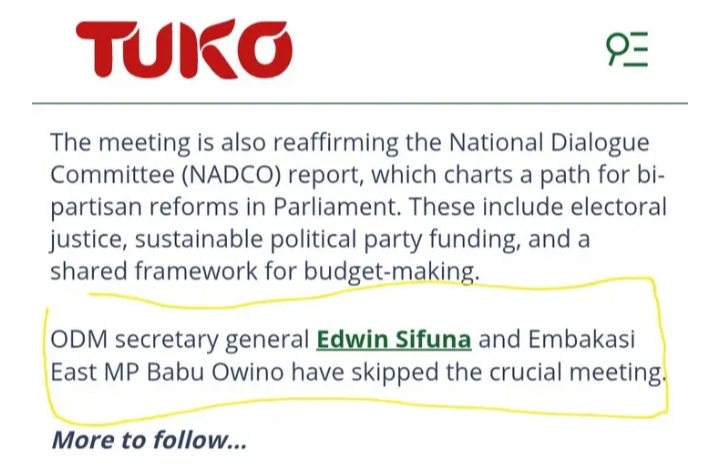
Lawmakers agreed that putting the report into action would create a strong basis for bipartisan collaboration and provide solutions to some of the country’s longstanding challenges.
Even with the show of unity, questions were raised following the absence of ODM Secretary General Edwin Sifuna and Embakasi East MP Babu Owino. Their decision to skip the meeting sparked speculation on whether all members of ODM were fully behind the growing partnership between Raila and Ruto.
Some MPs downplayed the concerns, noting that disagreements are part of political life, while others argued that the absence of two influential ODM figures might point to unease with the new direction the party leadership is taking.
Political observers noted that Edwin Sifuna, being the ODM Secretary General, has a major role in steering party decisions, and his absence could be viewed as a silent signal.
Babu Owino, who has built a reputation as a vocal figure with a strong youth following, also raised questions about what his political stance will be moving forward.
Their absence has therefore left the public guessing about possible divisions within ODM and how they might affect the broader cooperation.
Despite these uncertainties, MPs who attended the Karen meeting described it as a success. They highlighted the commitment shown by both leaders to build a joint agenda that addresses national challenges.
As one lawmaker remarked, “Kenyans do not want more political fights; they want leaders to work together to solve problems.” This statement captured the mood of the meeting and reflected the hope that bipartisan cooperation could bring practical solutions to the everyday struggles facing citizens.

