

The latest survey by the Ethics and Anti-Corruption Commission has exposed shocking levels of corruption in Kenya’s public institutions, with the Kenya Wildlife Service ranking as the most corrupt.
Released on August 5, 2025, the National Ethics and Corruption Survey 2024 placed KWS at the center of attention, after it was revealed that it demanded the highest average bribe of Sh200,000 and accounted for 35.73% of all bribes reported nationally.
These statistics have raised concerns about how the institution is being run, with many now questioning the leadership of Director General Erustus Kanga.
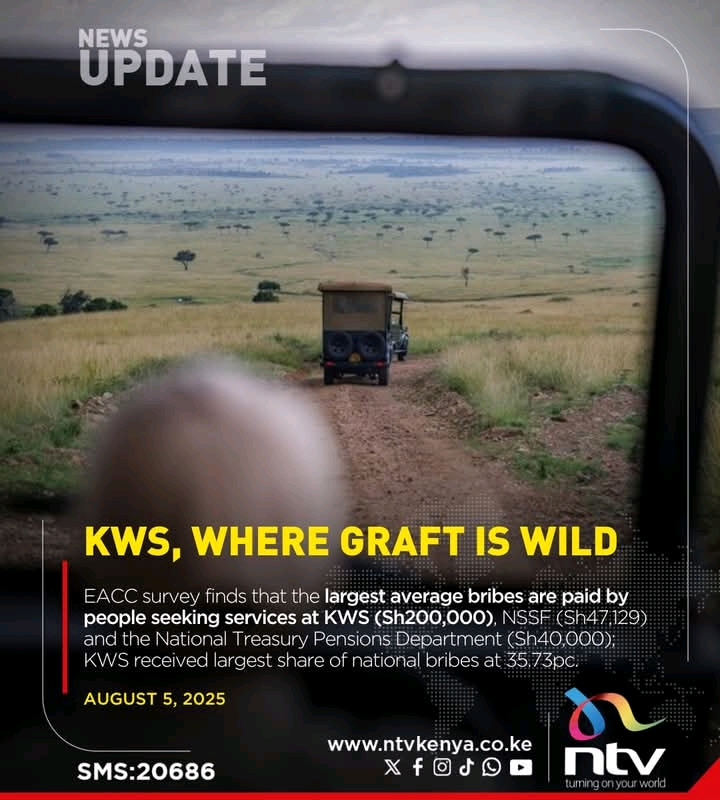
While other institutions such as the National Social Security Fund and the National Treasury Pensions Department followed with average bribes of Sh47,129 and Sh40,000 respectively, their figures pale in comparison to KWS.
The level of corruption at KWS appears to be on another scale entirely, raising fears that the rot runs deep and that it may be systemic.
The data clearly shows that this isn’t a one-off issue, but a major national concern that needs urgent action.
KWS’s corruption ranking is especially alarming because it is a critical agency entrusted with protecting the country’s wildlife and natural resources. Instead, it has become a hub of extortion, bribery, and unethical dealings.
The high amount of bribes being demanded implies the institution is no longer focused on service delivery but on extracting money from citizens and investors by any means possible. Such practices not only tarnish its reputation but also undermine conservation efforts and public trust.
Attention has naturally turned toward Director General Kanga, who is in charge of the institution. As the top official, many believe he cannot escape responsibility.
The scale of bribery reported under his leadership has made it difficult for him to avoid scrutiny. If these figures are accurate, then the leadership must be held accountable.
The public wants answers and expects reforms, not just press statements and internal investigations that lead nowhere.
The survey paints an even more disturbing picture. It found that over half of Kenyans seeking services from public offices offered bribes, showing that the problem is not just within institutions but deeply embedded in the public service culture.
Offering bribes stood at 52.1%, while 41.9% admitted to receiving bribes. This rising trend reflects a culture where corruption is not just accepted but expected, which is dangerous for a country trying to move forward.
With these findings now public, there is renewed pressure on the EACC to do more than just release reports. Action must be taken against those named in the corruption cases, starting with institutions like KWS that top the list.
The public wants to see high-level arrests, prosecutions, and the recovery of stolen funds. Anything short of this will be seen as business as usual.The eyes of the country are now firmly fixed on the Kenya Wildlife Service and its Director General.

