


Margaret Nduta Macharia, a 37-year-old Kenyan woman, has been spared from execution after the Vietnamese Supreme Court reduced her death sentence to life imprisonment.
This decision, made on Thursday, was welcomed with great relief by her family and the Kenyan government, which had been actively pushing for a more lenient sentence. Margaret had been convicted of drug trafficking, a serious offence in Vietnam that normally leads to a mandatory death penalty under the country’s strict anti-narcotics laws.
Her arrest and sentencing had shocked many in Kenya, prompting appeals for clemency from the public and human rights organisations.
Margaret’s case gained national attention in Kenya, with many people demanding that the government do more to protect its citizens abroad.
The calls were especially loud after it became clear that she was among the few foreign nationals facing capital punishment in Vietnam. In response, the Kenyan government launched diplomatic talks with Vietnamese authorities in an effort to save her life.
These efforts involved coordination between the Ministry of Foreign Affairs, Kenya’s embassy in Asia, and Margaret’s legal team. Although details of the talks have not been made public, officials confirmed that both high-level and behind-the-scenes negotiations took place over several months.
The court’s decision to spare Margaret’s life is seen as a success of this diplomatic pressure, even though she will still serve life in prison.
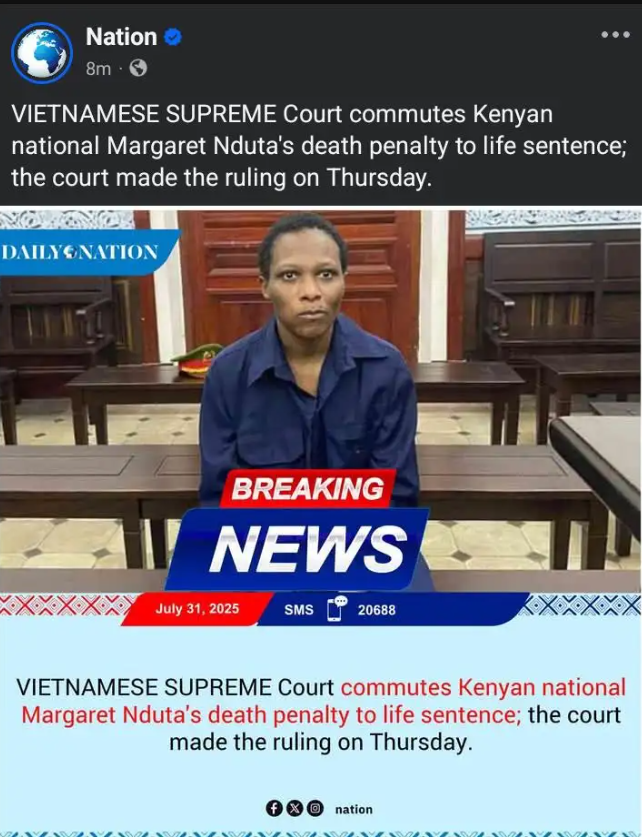
For her family, the ruling came as a major emotional relief after living with the fear that she could be executed far from home.
Her relatives, who have been vocal throughout the case, said they were thankful that the government intervened and that the Vietnamese authorities chose compassion over punishment.
Margaret’s lawyers also expressed their appreciation, stating that while life imprisonment is still harsh, it is far better than a death sentence.
This ruling now opens a new chapter in Margaret’s life, where she will continue to serve her sentence but with the hope of possible further interventions or even a transfer deal in the future.
Her case has also sparked fresh debate in Kenya about the dangers faced by citizens who travel abroad and fall into the hands of drug trafficking networks. Authorities have repeatedly warned the public, especially young people, about the risk of being used as drug mules without fully understanding the consequences.
Many Kenyans believe Margaret was a victim of manipulation and false promises. While the courts in Vietnam upheld her guilt, some still argue she may not have fully known what she was involved in.
Regardless of the circumstances, the decision to spare her life marks a significant moment in Kenya’s diplomatic efforts to protect its people.

