


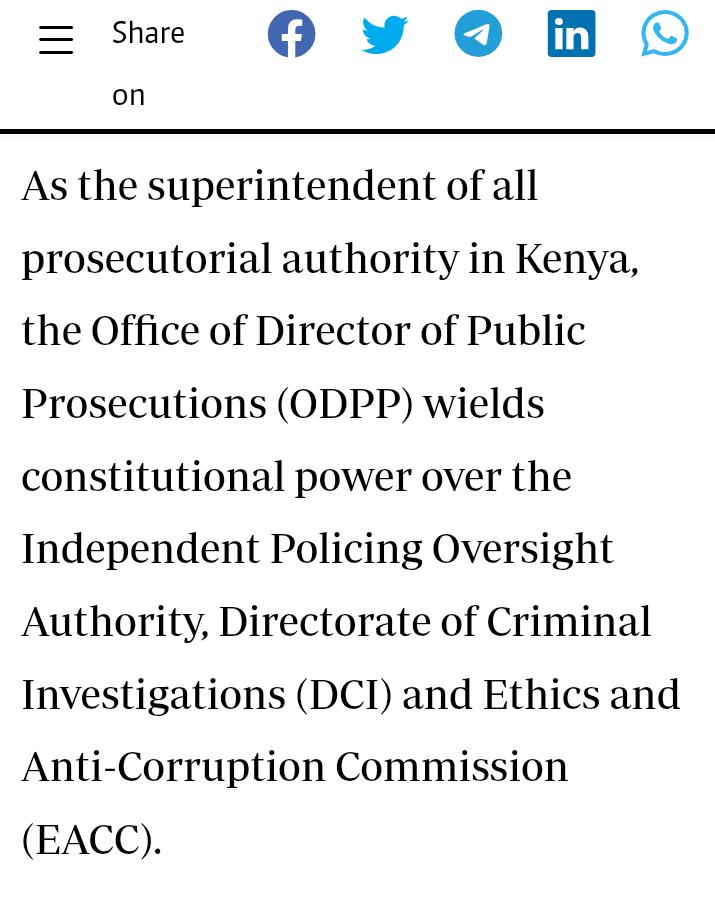
The Office of the Director of Public Prosecutions in Kenya is an important institution in the country’s fight against corruption. It works together with the Directorate of Criminal Investigations and the Ethics and Anti-Corruption Commission to handle cases of graft and economic crimes.
The ODPP is in charge of guiding investigations and prosecuting those suspected of corruption, which means it plays a central role in whether or not justice is served. Because of this power, some people have questioned whether the ODPP is doing enough to make sure that corruption cases are being investigated properly and taken to court effectively, especially when there are signs that the DCI is failing in its duties.
Many critics say that the ODPP should take part of the blame when DCI investigations are not done well. An opinion piece by Standard Media argued that since the ODPP has the power to direct and supervise investigations, it should be held responsible when those investigations are weak.
According to the article, the ODPP has not shown enough leadership in making sure that the DCI remains professional and thorough in its work. This argument means that the ODPP cannot sit back and ignore poor work done by the DCI, because it has the power to correct it before cases are taken to court.
However, it would also be unfair to say that the ODPP has failed completely. There have been moments when it performed very well. For example, in the financial year 2016/17, the ODPP recorded a conviction rate of 72.4 percent in corruption-related cases.
This was the highest rate ever recorded in Kenya at the time and was seen as a major success. Such achievements show that the ODPP can do its job well when investigations are properly done and there is enough cooperation among agencies.
These results make it clear that the ODPP cannot be fully blamed for every failed case.Even with these good results, there are still serious issues that must be addressed. One of the biggest problems facing the ODPP is the backlog of cases, which causes delays in prosecutions.
This problem has made the EACC push for the right to prosecute corruption cases on its own. The EACC believes that this would help speed up the process and improve the overall fight against corruption.
They argue that their success in civil cases like asset recovery shows they are capable, and that fewer delays would make the justice system more effective and reliable.
Still, the real situation is not black and white. There is a mixture of good performance and weaknesses. The ODPP has managed to secure convictions in the past, but the slow progress in some cases and poor coordination between key agencies remains a problem.
There needs to be more cooperation between the ODPP, DCI, and EACC. This has been mentioned by former top leaders like Keriako Tobiko and Uhuru Kenyatta, who said that institutions must work as a team instead of pointing fingers at each other.
When everyone works in isolation, it opens the door for corruption cases to fail.To truly move forward, Kenya needs not just strong laws but strong teamwork between institutions.
The ODPP should focus on maintaining high conviction rates, while also ensuring that investigations by the DCI are professional and fast. If giving the EACC more power can help speed up justice, then it should be considered.
Parliament should also be careful not to interfere too much in investigations, as this can confuse roles and delay justice further.In the end, the ODPP should not carry all the blame, but it must be held responsible where it has failed.
The focus now should be on fixing the weak links in the system, improving cooperation, and making sure that justice is done. Only then can Kenyans start to believe that the fight against corruption is being taken seriously and that no one is above the law.

